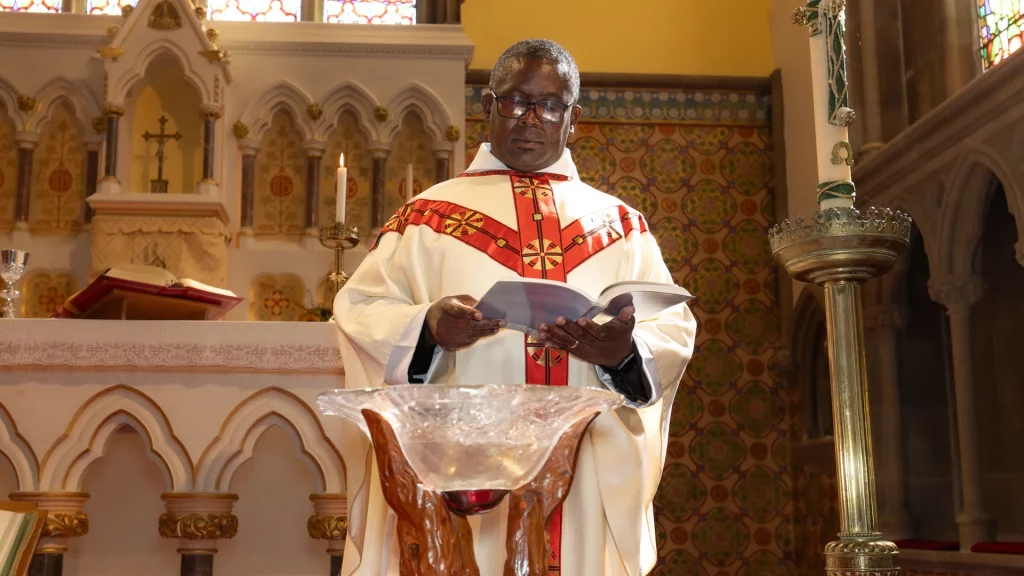
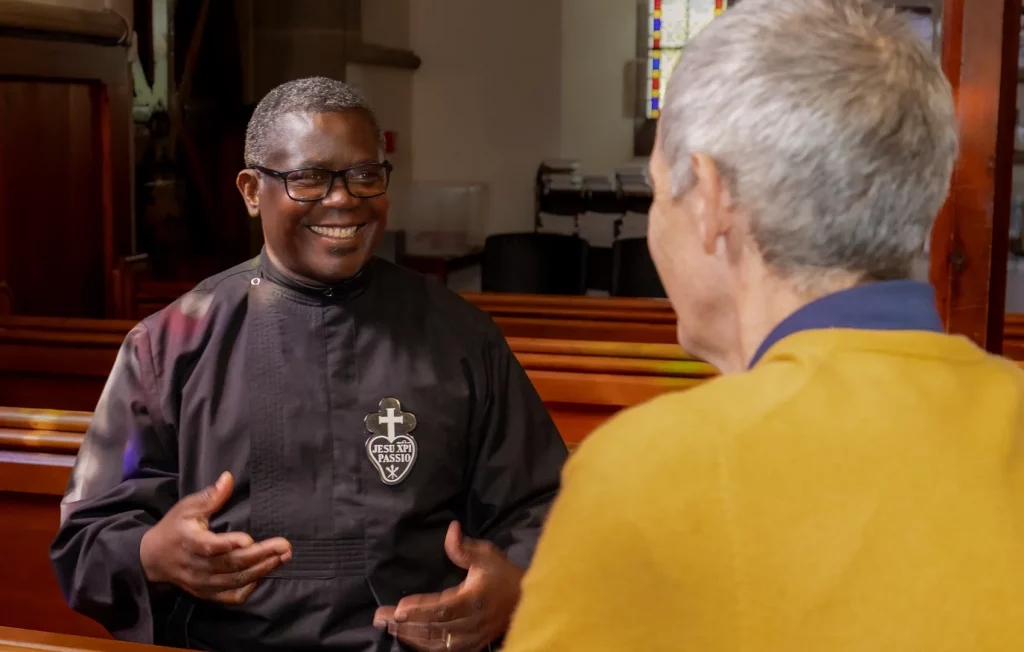
Fr Emmanuel Kabinga CP came to Minsteracres from Zambia. This is his story.
There is a moment Fr Emmanuel Kabinga CP returns to when he talks about what it means to be a priest.
He was alone in a small, dilapidated church in rural Zambia. No electricity. No running water. No toilet. No kitchen. Just a crumbling building in the bush that people gathered in occasionally when a priest happened to pass through. He had been ordained barely a month. He was 33 years old. And he was planning to leave.
“I was contemplating quitting,” he says, with the directness of a man who has long since made peace with the memory. “I had entered into a very serious crisis. I started making my own plans — plans to exit.”
He went to celebrate Mass that Wednesday afternoon not because he wanted to, but because there was no one else. His fellow priest was away in the city learning the language. The people were waiting. So Fr Emmanuel processed to the altar — unprepared, disengaged, his spirit elsewhere entirely.
Then something happened.
The Last Born of Eleven
Fr Emmanuel grew up in Zambia, the youngest of eleven children in a Catholic family. He was educated by the Jesuits — weekend retreats, youth programmes, a thorough grounding in Ignatian spirituality. But the priesthood? Not on his radar.
It was a friend who planted the seed, almost accidentally. The friend had been in touch with the Passionists and received some of their literature. He shared it with Emmanuel, gave him an address, and said: if you’re curious, you could write.
“I was not serious, really,” Fr Emmanuel admits. “I just said, okay, let me try.”
Three weeks later, the Passionists wrote back. They had received his application. They were inviting him to come and see.
Then came the twist. When the time finally came to travel to the formation programme in Botswana, Fr Emmanuel called his friend to confirm the arrangements.
“He said, ‘Ah — by the way, I’ve lost interest. I’m already in college studying journalism.'”
Fr Emmanuel laughs at the memory. But he went anyway. His parish priest had encouraged him. His family had been told. He had prepared. And so he travelled — alone, to a community he had never encountered before, to begin a life he had never quite planned.
“My journey started,” he says. “It has been exciting.”
Into the Bush
After his ordination, Fr Emmanuel was sent back to Zambia — to a remote rural mission where the Passionists had tried and failed before. He went with Fr Terence, a seventy-year-old with decades of missionary experience. Fr Emmanuel was thirty-three.
What they found was not a parish. It was a patch of bush with a derelict church. No house. No water. No sanitation. Nothing.
“The first few days were exciting,” he says carefully. “And then reality hit.”
The difficulties were not just practical. The place, he says, was spiritually dark. There were forces at work that a newly-ordained priest — one month out of seminary, inexperienced, far from everything he knew — was not equipped to interpret.
“I didn’t know how to make sense of the difficulties we were facing. I actually came to ask: is the priesthood about this?”
Fr Terence encouraged him. But encouragement, however well-meaning, did not reach the place Fr Emmanuel was in. He had stopped engaging. He was going through the motions. His spirit, as he puts it, was simply not there.
Wednesday Afternoon
On a Wednesday afternoon, Fr Emmanuel walked to the church to celebrate Mass. He had no choice — the people were waiting, and he was the only priest available. He was not prepared. He was not present. He was already, in his mind, somewhere else.
He sat in the presider’s chair while a reader stood for the first reading. And then, not quite paying attention, he opened his eyes and looked towards the back of the church.
At the entrance — a simple church with two open doors — he saw something. A large cross, filling each doorway. He removed his glasses. He looked again. It was still there.
“I said: what is this? Am I dreaming?”
He checked the second door. The same.
He read the Gospel. He shared a few words. And then came the moment of consecration — the point in the Mass where the bread and wine are offered. Fr Emmanuel raised the host.
“It was like I was holding flesh. Like somebody warm, as warm as you are. Like somebody breathing.”
He pauses in the telling, even now, as though the weight of it is still there.
“That is when I began to understand what it means to be a Passionist. Through all the sufferings, all the challenges — in the depths of my crisis — he said: I am alive. I am here with you.”
A passage of scripture came to him. Matthew 7:7-11. Ask, and it will be given to you. Seek, and you will find. Knock, and the door will be opened.
“That was the beginning of my vocation,” he says. “I came to believe: this is where I am supposed to be.”